About the project
The React interface and Phaser scenes share mission state. Showing the result and restarting must not leave state from the previous attempt.
A game about a courier on the Moon. Mission selection, routes, radio events and shift results. React handles the interface; Phaser handles the game scenes. It runs in the browser without a backend.
- Route control is designed for a mouse and keyboard. Mobile screens are responsive, but full touch-based routing is not claimed.
- The first available commit is a baseline of an already completed stage, so it does not establish when development began.
- No external integrations or server database: the mission runs in the browser.
Screenshots, diagrams and source evidence retain their original language; captions and descriptions are translated.
Architecture and diagrams
- React handles the interface; Phaser handles the canvas and game loop.
- Level selection, briefing, mission and result are separate states.
- After a defeat, replay returns to the briefing; a new shift starts through an explicit action.


Code map: files and dependencies
This map is tied to version b6b24e121536. The table lists the screen or API, related module and data.
| Feature | Screen / API | Module | Data / verification |
|---|---|---|---|
| Startup | Selection / briefing | src/ui/store/gameStore.ts; src/game/createGame.ts | level config; production browser QA |
| Route | Canvas | src/game/MapScene.ts; simulation/routing/confirmRouteDraft.ts | routeDraft / findWeightedRoute; actual route |
| Events | Radio panel | simulation/radio/createRadioJournal.ts | formatRadioEvent; game history |
| Simulation | Mission / result | simulation/createSimulationEngine.ts; clock/fixedStepClock.ts | courier and hub states; unit suite |
| Mobile view | Preflight / radio | React styles / src/ui | 390px; no-overflow QA |
Using the code map
- Before making a change, find the feature and trace its links to the API, state and storage.
- Check inputs, errors, repeated events and dependent workflows.
- After making a change, update the map and affected diagrams alongside the code.
- Run the related checks and link the new evidence to the source version.
Workflows and API
- Choose a level and read the briefing.
- Start a shift, select a courier and assign a route.
- Open the radio panel and follow a mission event.
- Wait for the result, select replay and start a new shift from the briefing.
Verification of the published version
- Original full suite: 464 unit tests, 20 E2E tests and one skipped test. Production build, asset checks and mobile QA were repeated after the CSS change.
- Production build / assets
- Desktop route and actual defeat/replay
- Mobile levels, briefing, radio; no overflow
- No verified GitHub CI run is available for this SHA; the listed evidence covers local checks and published-version scenarios. Historical CI links, where available, are labeled separately.
These checks apply to the listed version. Business metrics and model quality on an independent dataset were not measured.
Measurements
- 15 meaningful screenshots of the actual interface retained.
- Each screenshot includes its date, scenario and code revision.
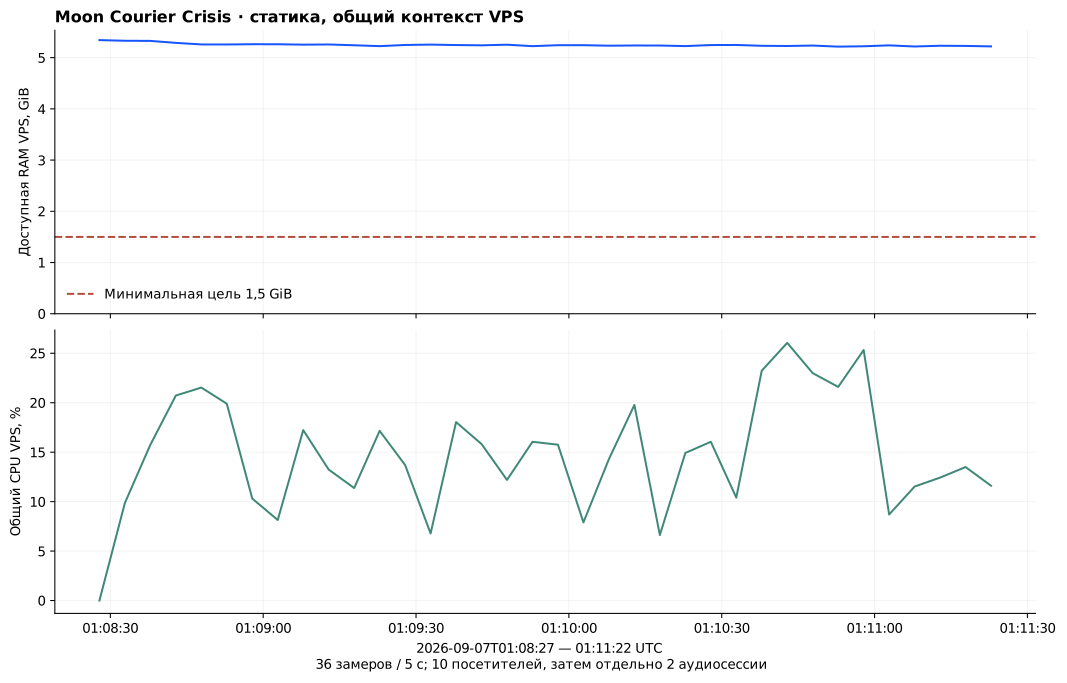
- No separate backend process runs on the VPS: Nginx serves static files. Shared Nginx resources cannot fairly be attributed to a single site.
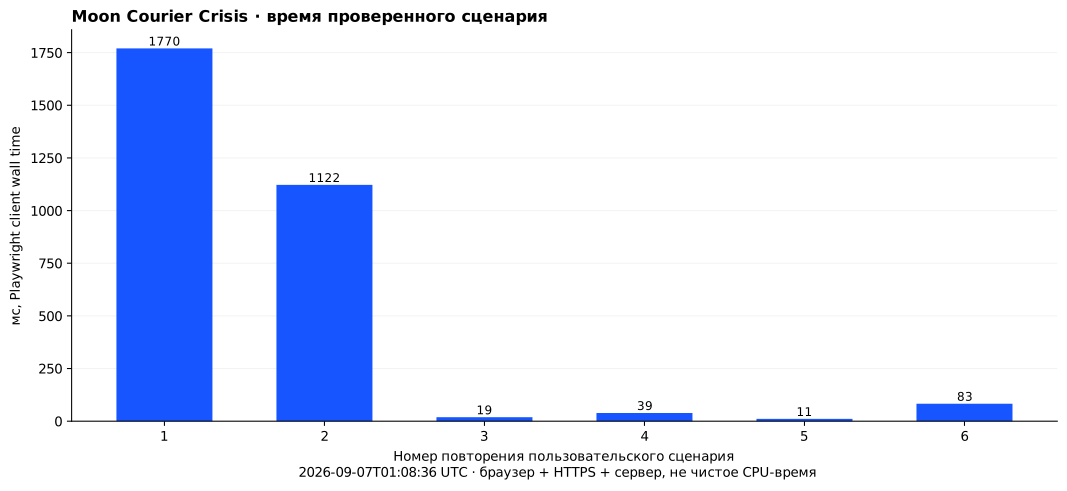
- 6 scenario repetitions measured; median 61.0 ms, maximum 1770 ms. Timing includes the browser and HTTPS; methodology and limitations are included.
Running and operating
The game runs in the browser. The server serves static files; there are no payment or AI integrations.
The production build, TypeScript checks and asset checks run outside the VPS. Nginx serves the resulting directory; there is no persistent backend.
Verify actual mission states without replacing the outcome through test hooks. Evidence includes a real defeat and replay. Screenshots from different releases are labeled individually; the mobile change affects layout rather than game mechanics.
Builds run outside the VPS; the server receives static files and versioned images. Secrets are kept separately. Logs rotate; changing log options requires recreating the container. No server-wide docker prune.
The code map links a screen or API to its module and data. A change needs those links checked, the map updated and the affected flows rerun: normal path, error, retry and reset. Diagrams can go stale, so their version is listed alongside them.
Rollback checked at 2026-09-07T00:59:40.423436+00:00: 20260907-verified → 20260907b → 20260907-verified. HTTPS, readiness and SHA were confirmed after each switch. This checks configuration and artifacts at one verified SHA; no reverse database migration was performed.
Stack
| React | Briefing, panels, hints and mission result. |
|---|---|
| Phaser | Canvas, game loop, scenes, routes and objects. |
| TypeScript / Vite | Game model, production build and asset checks. |
Materials and source code
Retained stage history: August 2026; development start is unknown. Demo published: 7 September 2026.
The evidence archive retains its original language.